I found out the hard way that a freezer humming quietly in the corner isn’t the same as a freezer doing its job. A few winters back I opened mine to grab some batch-cooked soup and found the containers slushy at the edges. Not frozen solid. Just cold. Everything in there, months of meals I’d carefully portioned and stacked, was sitting somewhere in that murky zone where you can’t quite trust any of it. I threw most of it out. That hurt more than the money. It was the wasted effort.
What got me was that the freezer looked fine. The light came on. It felt cold when I stuck my hand in. The dial was set to what I’d always assumed was “cold enough.” But assuming isn’t measuring, and my freezer had been drifting warm for who knows how long without me noticing.
So I did what I always do when something burns me. I went down a rabbit hole and learned how this actually works. And it turns out the ideal freezer temperature isn’t a vibe or a dial setting. It’s a specific number, it’s easy to hit once you know it, and getting it right is the difference between food that’s genuinely safe and food that’s quietly deteriorating while you trust it. Here’s everything I wish I’d known before I lost that batch.
What Is the Ideal Freezer Temperature?
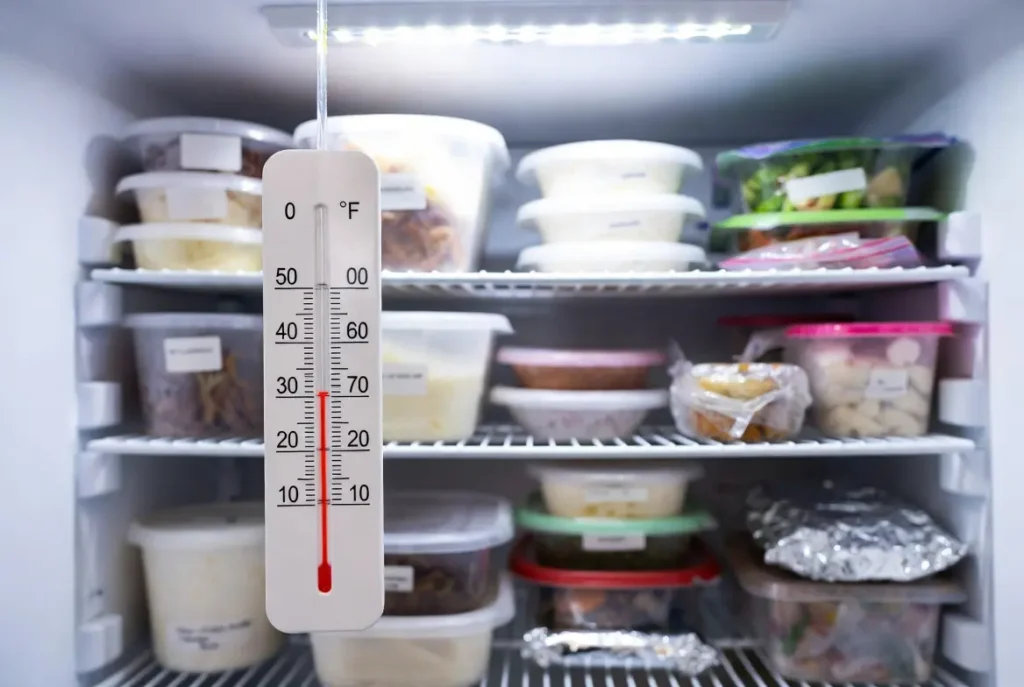
Let’s start with the number, because it’s the whole point. The ideal freezer temperature is 0°F, which is -18°C. That’s the figure food safety authorities in the US, including the FDA and USDA, point to, and it’s the target you actually want your freezer holding, not just approaching.
Here’s the part that surprised me. Zero isn’t the temperature that keeps food merely frozen. Water freezes at 32°F, so technically your food would be solid well above zero. The reason 0°F is the recommended ideal freezer temperature is that it’s cold enough to bring the activity of bacteria, yeasts, and molds to a near-total standstill. At that temperature, the microorganisms that spoil food and make you sick essentially go dormant. They don’t die, but they stop growing, and that pause is what protects both the safety and the quality of what you’ve stored.
There’s a common mix-up worth clearing up right away, because I made it myself. Your freezer and your fridge are two different targets. The fridge should sit at or below 40°F to slow spoilage, while the freezer wants that much colder 0°F to essentially halt it. Two appliances, often one unit, two completely different jobs. Setting one “cold” in your head doesn’t tell you anything real about either.
And that word “ideal” matters. It’s not a minimum you should hover near. It’s the sweet spot. A little colder is fine and won’t hurt your food, though it costs more to run. Warmer, even by several degrees, and you slide toward the range where food quality drops fast and, over time, safety starts to matter too. So the goal is simple to say and worth taking seriously: get your freezer to 0°F and keep it there.
Why 0°F Is the Number That Matters
Once I understood what’s happening inside a freezer, the number stopped feeling arbitrary. Freezing doesn’t sterilize your food. This was the myth I’d been running on for years. I assumed the freezer was some kind of kill switch, that anything frozen was frozen safe, full stop. It isn’t.
What freezing actually does is press pause. At 0°F, the bacteria and other microbes already on your food are still there, they’re just knocked into dormancy and can’t multiply. The moment food warms back up, they wake up and carry on exactly where they left off. That’s why thawing food on the counter all day is risky even though it came out of a safe freezer. The safety was borrowed, not permanent, and it ends the moment things warm up.
This also explains why a freezer drifting warm is such a quiet problem. Between 0°F and 32°F, your food can still look and feel frozen while microbial activity slowly creeps back in and quality degrades. You don’t get an obvious alarm. You get slush at the edges, ice crystals forming and reforming, and food that’s technically “frozen” but no longer protected the way you think it is. My slushy soup wasn’t a dramatic failure. It was a slow drift I simply hadn’t been measuring.
There’s a quality dimension too, not just safety. Colder, steadier temperatures mean smaller ice crystals forming in your food, which means less damage to its texture when you thaw it. Big temperature swings grow big, jagged ice crystals that rupture cell walls, which is why food from an unreliable freezer often comes out mushy or dried out even when it’s perfectly safe to eat. Holding a steady 0°F protects how your food tastes, not just whether you can eat it.
How to Actually Set Your Freezer Temperature
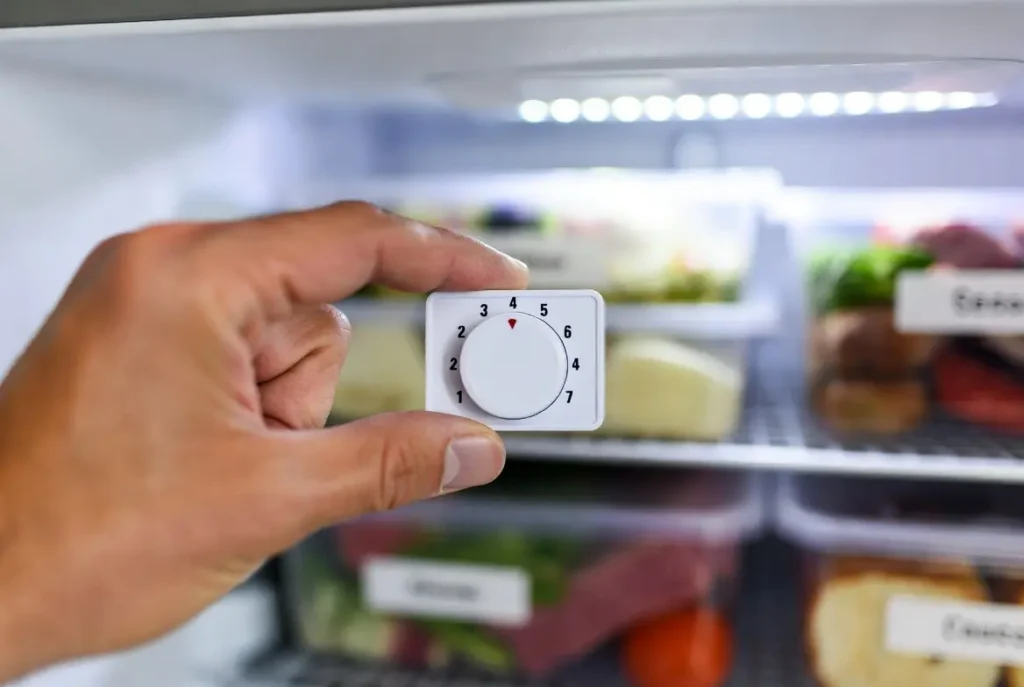
Here’s the frustrating truth I ran into. Most freezers don’t let you set an actual temperature. You’d think “set it to 0°F” would be the end of the article, but many freezers, especially the fridge-freezer combos most of us own, have a dial or slider marked with numbers like 1 through 7, or just “min” to “max.” Those numbers aren’t degrees. They’re vague intensity settings, and a 4 on your freezer might land somewhere completely different from a 4 on mine.
So setting your freezer correctly is really a two-part job. First, if you have a digital control that shows actual temperatures, set it to 0°F or -18°C and you’re most of the way there. Lucky you. Second, if you’ve got the dial-with-numbers situation, you can’t set by degrees, so you have to set by measuring, which I’ll walk through in the next section. A rough starting point for those dials is somewhere in the middle, then you adjust based on what you actually measure.
A few practical notes from my own trial and error. When you change the setting, give it time. A freezer doesn’t jump to a new temperature instantly. It can take a full day, sometimes longer, for the interior to stabilize at a new setting, so resist the urge to keep twiddling the dial every few hours. Set it, wait about 24 hours, then measure. If you’re too impatient, you’ll chase your own tail, cranking it colder and colder based on readings that haven’t settled yet.
And check your manual if you still have it, or look it up online. Some units have quirks, like a single control that governs both the fridge and freezer, where changing one affects the other. Knowing how your specific appliance behaves saves a lot of guesswork.
How to Check Your Freezer Is Really at 0°F
This is the step almost nobody does, and it’s the one that would have saved my soup. You cannot tell your freezer’s temperature by hand, by eye, or by faith. You measure it. The tool costs very little and it’s the single best thing you can buy for your freezer.
Get an appliance thermometer, sometimes sold as a fridge and freezer thermometer. It’s a small, cheap gadget designed to sit inside and read those low temperatures accurately, which a regular room thermometer often can’t. Here’s how I use mine.
Place the thermometer somewhere in the middle of the freezer, not jammed against the back wall or the door, since those spots run colder and warmer than the true average. Let it sit for a good while, ideally overnight or at least several hours, so it reads the settled temperature rather than a brief spike from you opening the door. Then read it. If it says 0°F or a touch below, you’re golden. If it’s reading warmer, nudge your dial colder, wait another day, and measure again. Repeat until you land on zero.
I now leave a thermometer in there permanently and glance at it every so often. It takes two seconds and it means I’ll catch a drift like my old one long before it turns into a bin bag full of wasted food. For a chest freezer or a second deep freezer where you store a lot of value, this habit matters even more, because those units get opened less and a slow failure can go unnoticed for weeks.
One honest caveat. Frost-free freezers run a periodic defrost cycle, during which the temperature rises briefly on purpose before dropping back down. So if you happen to catch a reading that’s a little warm, don’t panic and crank the dial immediately. Check again later. You want the temperature it holds most of the time, not a snapshot from the middle of a defrost cycle.
What Throws Your Freezer Temperature Off
A freezer set correctly can still drift warm if you fight it, and I’ve made most of these mistakes. Knowing them helps you hold that 0°F without constantly fiddling.
How full it is matters, in both directions. A well-filled freezer actually holds its temperature better, because all that frozen mass acts like a cold battery, staying cold and helping everything recover fast when you open the door. An almost-empty freezer has nothing but air to cool, so it warms quickly every time you open it and works harder to recover. But there’s a limit. Cram it so full that you block the internal vents and you choke the airflow the freezer needs to circulate cold, which creates warm pockets. The goal is full but not stuffed, with air able to move.
Opening the door is the obvious one, and worse than most people think. Every time you open it, cold air spills out and warm, humid room air rushes in, which the freezer then has to chill back down. Standing there with the door open deciding what to eat is a small tax every time. I try to know what I’m grabbing before I open it, and I don’t leave it hanging open while I unpack groceries.
Where the freezer lives affects it too. Put a freezer next to an oven, a radiator, or in a spot that gets direct sun, and it has to work against that heat constantly, which can push its interior warmer than the dial suggests. Mine improved noticeably once I stopped keeping it beside a heat-throwing appliance. Freezers also need breathing room around them to shed their own heat, so shoving one into a tight cabinet with no clearance works against you.
And loading in warm food in bulk will spike the temperature. When I add a big batch of just-cooled cooking, I know it nudges the freezer warmer for a while as it works to freeze it all. Letting food cool down before it goes in, and freezing large amounts in smaller portions rather than one giant block, helps everything freeze faster and keeps the overall temperature steadier. Heavy frost buildup on older units insulates the coils and hurts efficiency too, so if yours isn’t frost-free, defrosting it occasionally keeps it running at its target.
Freezer Temperature, Safety, and Food Quality
Here’s a distinction that changed how I think about my freezer. Safety and quality are two different things, and 0°F protects both, but not in the same way.
On safety, the reassuring news is that food kept genuinely frozen at 0°F stays safe essentially indefinitely, according to the USDA’s guidance on freezing and food safety{:rel=”nofollow”}. That frozen-solid chicken from a year ago is, from a pure safety standpoint, still safe to cook and eat if it’s been held at 0°F the whole time. Freezing at the right temperature is remarkably protective. The catch is that “safe” and “good” aren’t the same word.
Because on quality, time still marches on, just slowly. Even at a perfect 0°F, food gradually loses texture, flavor, and moisture over months. This is where freezer burn comes in, those grayish, dried-out patches you’ve probably seen on long-stored food. Freezer burn is air reaching the food’s surface and drawing moisture out of it. It’s not a safety problem, and you can cut those patches off or eat around them, but it’s a quality problem, and it’s the freezer’s slow way of telling you that food has been in there a long time or wasn’t wrapped airtight.
So the practical takeaway I landed on is this. Trust 0°F to keep your food safe for a long time, but don’t treat the freezer as a place where food is frozen in time forever at full quality. Wrap things well to keep air out, label them with dates so you’re not guessing, and rotate through them within a reasonable window for best results. Safe indefinitely, best within months. Both things are true at once.
Special Situations Worth Knowing About
A few scenarios come up often enough that they’re worth having answers ready, because they’re exactly when freezer temperature suddenly matters a lot.
The big one is a power outage. This is where a full freezer really earns its keep. According to the USDA, a freezer that’s full will hold a safe temperature for roughly 48 hours if you keep the door shut, while a half-full one holds for about 24 hours. The single most important rule is to keep the door closed. Every peek lets cold escape and shortens that window. When power comes back, don’t judge by looks. Check the food. If items still contain ice crystals or the freezer held at or below 40°F, they’re generally safe to refreeze or cook. This is genuinely a safety matter, so when you’re unsure about a particular item, especially meat, poultry, or seafood, the safest move is to throw it out rather than gamble.
On refreezing more generally, since it worries people, thawed food that still has ice crystals or that stayed at 40°F or below can usually be refrozen safely, though its quality may take a hit each time. What you don’t want to do is refreeze food that’s been sitting warm for hours.
And on freezer types, chest and dedicated upright freezers tend to hold a steadier, colder temperature than the freezer compartment of a standard fridge-freezer, partly because they’re opened less and built for the job. If you keep a separate deep freezer for bulk storage, it’s a great candidate for a permanent thermometer, since it often holds real value and gets checked rarely. The target is the same across all of them though. Zero degrees Fahrenheit is the number, whatever the shape of the box.
My Honest Take
If I’m honest, the thing that stuck with me most isn’t a temperature. It’s the habit. For years I treated my freezer as a set-and-forget appliance, something that either worked or didn’t, and I never once thought to measure whether it was doing what I assumed. That blind trust is exactly what cost me a freezer full of food.
What actually fixed the problem wasn’t knowing that 0°F is the ideal freezer temperature, though that helped. It was spending a few dollars on a thermometer and building the two-second habit of glancing at it. That’s it. That’s the whole upgrade. Everything else in this article is useful context, but if you take away one action, let it be that. Measure, don’t assume.
I’ll also say, gently, that I’m not a food scientist. I’m someone who got burned, got curious, and dug into what the actual food safety authorities say so I could stop repeating my own mistakes. For the safety-critical calls, especially anything involving whether questionable food is safe to eat, I lean on official guidance from bodies like the USDA and FDA rather than my own gut, and I’d encourage you to do the same. When in real doubt about a specific food, the boring advice to throw it out is boring precisely because it’s right.
Frequently Asked Questions
What is the ideal freezer temperature?
The ideal freezer temperature is 0°F, or -18°C. That’s the figure recommended by US food safety authorities like the FDA and USDA. It’s cold enough to bring the activity of bacteria, yeasts, and molds to a near standstill, which protects both the safety and the quality of your frozen food.
Is 0°F cold enough, or should my freezer be colder?
Zero degrees Fahrenheit is the recommended target and is cold enough to keep food safe. A little colder won’t harm your food, though it uses more energy. The important thing is not letting it drift warmer than 0°F, since that’s when quality drops and, over time, safety becomes a concern.
Why isn’t my food frozen if the freezer is below 32°F?
It likely is frozen, but frozen isn’t the same as ideal. Water freezes at 32°F, so food can be solid well above zero. The reason 0°F is recommended is that it halts microbial activity, not just freezes the water. Between 0°F and 32°F, food can feel frozen while quality slowly degrades.
How do I check my freezer’s actual temperature?
Use an inexpensive appliance thermometer. Place it in the middle of the freezer, away from the walls and door, leave it for several hours or overnight, then read it. If it reads 0°F or slightly below, you’re set. If it’s warmer, adjust the dial colder, wait about a day, and measure again.
My freezer only has a dial from 1 to 7. How do I set it to 0°F?
Those numbers are intensity settings, not degrees, so you can’t set 0°F directly. Start somewhere in the middle, wait about 24 hours, then measure with an appliance thermometer. Adjust up or down based on the reading, waiting a day between changes, until it holds at 0°F.
How long can food stay frozen and still be safe?
Food held continuously at 0°F stays safe essentially indefinitely, according to the USDA. Safety and quality are different, though. Over months, even properly frozen food loses texture and flavor and can develop freezer burn, so “safe indefinitely” doesn’t mean “best forever.” Wrap well, label with dates, and use within a reasonable window.
How long will my freezer stay cold during a power outage?
With the door kept shut, a full freezer holds a safe temperature for roughly 48 hours and a half-full one for about 24 hours, per the USDA. Keep the door closed as much as possible. When power returns, check the food. Items with ice crystals still present, or that stayed at or below 40°F, are generally safe to refreeze or cook.
Conclusion
The ideal freezer temperature is 0°F, or -18°C, and that single number does a lot of quiet work. It’s the point where the microbes that spoil food and make you sick go dormant, where your food stays genuinely safe for the long haul, and where quality holds up best over time. Anything warmer, even by a handful of degrees, and you start trading that protection away without any obvious warning, which is exactly the trap I fell into.
But knowing the number isn’t what protects your food. Measuring is. So here’s your action step, and it’s a small one. Buy a cheap appliance thermometer, put it in the middle of your freezer, and check it in a day or two. If it reads 0°F, wonderful, now leave it in there and glance at it now and then. If it doesn’t, adjust, wait, and measure again until it does. That ten-minute habit is the entire difference between a freezer you trust and a freezer you’re hoping is fine. I learned that the expensive way. You don’t have to.
About the Author
Muazzam Ali is the founder of HealthAndFoodGuide.com, where he’s building a practical, no-nonsense library of food storage and safety guides for regular home kitchens. His interest is hands-on rather than academic. He started digging into how food storage really works after one too many avoidable spoiled-food disasters of his own, and now spends his time turning what the food safety authorities actually recommend into plain, usable advice. For safety-critical questions, he defers to and points readers toward official sources like the USDA and FDA rather than guesswork, because when it comes to what you eat, getting it right matters more than sounding clever.