The first time I tried to freeze milk, I did just about everything wrong. I grabbed a full, unopened jug from the fridge, shoved it straight into the freezer, and felt clever about beating the expiration date. Two days later I had a jug bulging at the sides, a cracked cap seal, and a puddle of half-frozen milk pooling under everything. Turns out milk expands when it freezes, quite a lot, and a full sealed container has nowhere to put that extra volume. Lesson one, learned the messy way.
The next jug I thawed on the counter overnight because I was impatient, then poured myself a glass and nearly gagged. It had separated into watery liquid and grainy little fat clumps, warmed up more than it should have, and looked nothing like milk. I tipped it down the sink and assumed freezing milk simply didn’t work. Lesson two, also wrong, but for a subtler reason.
It took a few ruined jugs and some actual reading before I understood that yes, you absolutely can freeze milk, and it’s genuinely useful once you know the handful of small things that make the difference between a usable result and a mess. So let me save you my mistakes. Here’s exactly how to freeze milk the right way, what to expect when you thaw it, and where it works brilliantly versus where it lets you down.
Can You Freeze Milk?
Yes, you can freeze milk, and it’s completely safe to do. Freezing doesn’t make milk unsafe or spoil it. What it changes is texture and appearance, not safety, and once you know that distinction, the whole thing gets a lot less intimidating.
Here’s the honest version though. Can you freeze milk successfully depends almost entirely on doing a few things right and having realistic expectations. Frozen and thawed milk often looks a little different from fresh. It can separate, turn slightly yellowish, and go a touch grainy. None of that means it’s gone bad. It’s just what happens when you freeze an emulsion of water, fat, and proteins and then bring it back. A good shake usually pulls it back together, and for most uses you’d never notice.
The key thing to hold onto is the safety-versus-quality split, the same idea that runs through most freezing questions. On safety, milk frozen while it’s still fresh and kept properly frozen stays safe to use. On quality, it slowly changes over time and comes back slightly different, which is why frozen milk shines in some situations and disappoints in others. Get that framing right and you’ll never again dump a perfectly good jug the way I did, just because it looked a bit odd.
One quick note before the how-to. All of this assumes your freezer is actually doing its job. Milk, like anything else, needs to be held at a genuinely cold, steady temperature to stay good, so it’s worth making sure your freezer is set to the ideal freezer temperature of 0°F before you count on it to preserve anything. A freezer drifting warm will let quality slide no matter how carefully you pack things.
Why Freeze Milk at All?
Before the method, it’s worth being clear on when freezing milk is actually worth the bother, because it isn’t always.
The biggest reason, and the one that converted me, is waste. Milk has a frustrating habit of turning right as you stop needing it. You buy a jug for one recipe, use a cup, and watch the rest inch toward its date. Freezing lets you hit pause on that countdown instead of pouring money down the drain. If a jug is approaching its date and you know you won’t finish it, freezing it is far better than binning it later.
Stocking up is the other big one. When milk goes on sale, or when you’re facing a stretch where you can’t easily get to a shop, freezing lets you buy ahead without racing the clock. I keep a couple of portions frozen as backup so I’m never completely out for coffee or cooking. This turned out to be genuinely useful the winter I got snowed in for the better part of a week. While I was rationing what was in the fridge, I remembered the flat-frozen bags in the door of the freezer, and a morning coffee that would otherwise have been black suddenly wasn’t a problem. That’s the moment freezing milk stopped being a tidy idea and became something I actually do without thinking.
And it’s genuinely handy for cooking and baking. If you regularly need small amounts of milk for recipes, having pre-portioned frozen milk means you’re not opening a fresh jug just to use a splash. That said, if you drink milk fast and finish jugs well before they turn, freezing might solve a problem you don’t have. It’s a tool for waste and convenience, not something you need to do for its own sake.
How to Freeze Milk the Right Way
This is where my early disasters turned into a reliable routine. Freezing milk well comes down to a few specific moves, and none of them are hard once you know them.
Start with fresh milk. Freeze it while it’s still well within date, not as a last-ditch rescue for milk that already smells off. Freezing preserves milk roughly in the state it went in, so garbage in, garbage out. If it’s questionable before freezing, it’ll be questionable after.
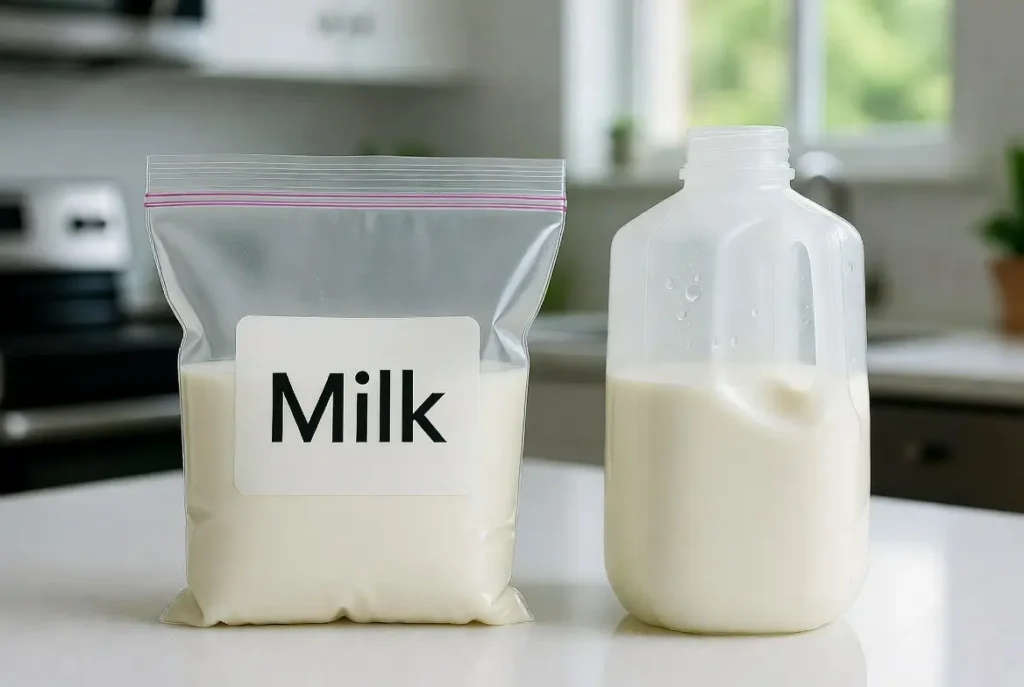
Then deal with the expansion, which is the mistake that cost me my first jug. Milk expands as it freezes, so the container needs room to grow. Never freeze a completely full, sealed jug. If you’re freezing milk in its original plastic container, pour off a good cup or so first to leave headspace, then re-cap it loosely. Better yet, portion it into freezer bags or rigid containers with room left at the top. Freezer bags are my favorite because you can lay them flat to freeze into thin slabs that stack neatly and thaw fast.
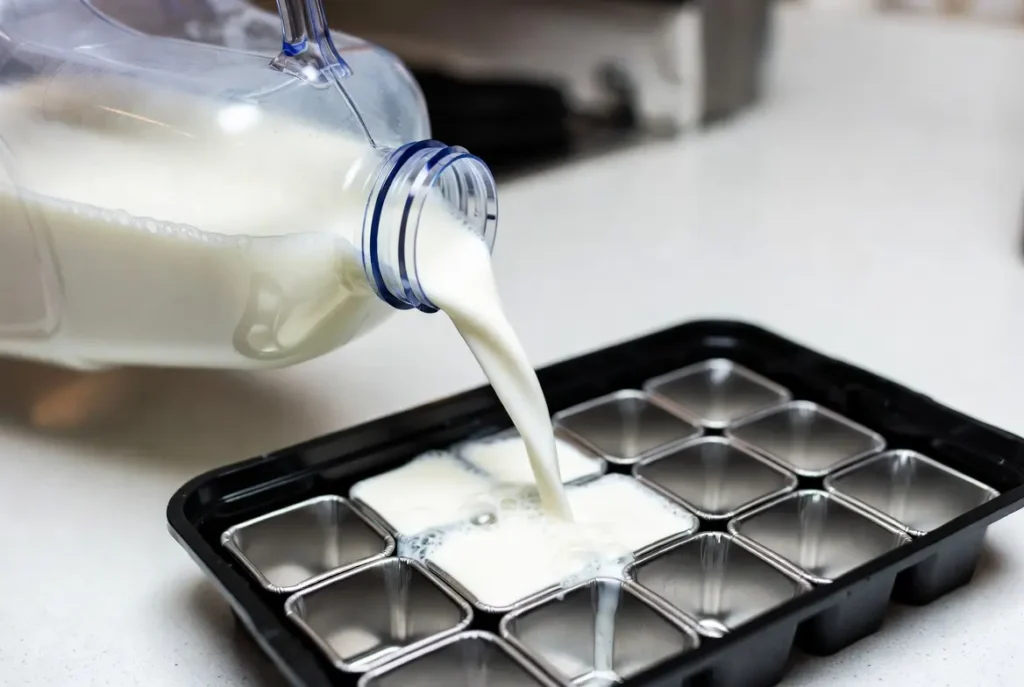
Portion it in amounts you’ll actually use. This was a quiet game-changer for me. Freezing a whole liter in one lump means thawing the whole thing every time you want a splash. Instead, freeze it in the sizes you tend to need, a cup for recipes, a mug’s worth for coffee runs, or even milk cubes in an ice cube tray for tiny amounts. Then you only thaw what you need.
Finally, label and freeze it fast. Write the date on every container, because frozen milk is genuinely hard to identify later and you’ll want to use it within a sensible window. I also jot down the type, since a frozen bag of skim and a frozen bag of whole look identical once they’re solid, and I’ve mixed them up more than once. Lay bags flat and give them a little space so they freeze quickly, since faster freezing means smaller ice crystals and better texture when it comes back. That’s it. Fresh milk, headspace for expansion, useful portions, a date, and a quick freeze.
One extra tip that took me embarrassingly long to figure out. Don’t stack a warm, freshly filled bag on top of already-frozen items and expect either to do well. The warm bag freezes slowly sandwiched in there, and it nudges its frozen neighbors warmer in the process. I freeze new bags flat and slightly apart on a shelf or tray first, then once they’re solid I stand them up or stack them to save space. It’s a small thing, but it’s the difference between milk that freezes fast with good texture and milk that sits half-frozen for hours picking up bigger ice crystals.
[IMAGE: Milk being poured into an ice cube tray for small frozen portions]
What Happens to Milk When You Freeze It
Knowing what to expect is half the battle, because the changes look alarming the first time and they’re almost always fine.
The color often shifts. Frozen milk can take on a yellowish tinge, which throws people off but is completely normal. It’s just how the fats and proteins look concentrated in the frozen state, and it doesn’t mean the milk has spoiled.
Separation is the big one. When milk thaws, the fat can separate from the watery portion, leaving you with liquid and little grainy clumps or a layer that won’t quite blend back in on its own. Again, this is a texture change, not spoilage. The fix is simple. Give thawed milk a really good shake, or even a quick whizz with a blender or whisk for stubborn cases, and it usually comes back together well enough that you’d struggle to tell in most uses.
The texture can end up very slightly grainier than fresh, especially with higher-fat milk. For a lot of people this is imperceptible once the milk is in coffee, a sauce, a smoothie, or baking. For drinking a cold glass straight, some people notice it and some genuinely don’t. I fall into the “don’t really mind” camp for coffee and cooking, but I’ll be honest that thawed whole milk in a plain glass isn’t quite the same experience as fresh. That’s the trade, and it’s worth knowing up front rather than discovering mid-sip like I did.
How to Thaw Frozen Milk Safely
Thawing is where I made my second big mistake, and it’s the step where a little patience really pays off, including for safety.
Thaw milk in the fridge, not on the counter. This is the important one. Leaving milk out at room temperature to thaw lets the outside sit in the warm range where bacteria get going again while the inside is still frozen, which is exactly the situation you want to avoid with any perishable food. Fridge thawing keeps the whole thing in the safe cold zone the entire time, which is the same principle food safety authorities apply to thawing any perishable, and the USDA’s guidance on freezing and food safety{:rel=”nofollow”} spells it out clearly. Move it from freezer to fridge and let it thaw there. It’s the safe way and it’s genuinely worth the wait.
Give it time. A small portion or a flat bag thaws fairly quickly in the fridge, often within several hours, while a larger container can take a day or even two to thaw fully. So plan ahead rather than deciding at breakfast that you want milk that morning. If you’re in a genuine hurry, you can speed a sealed bag or container along by setting it in a bowl of cold water in the fridge or under cold running water, but skip the warm-water and countertop shortcuts.
Once it’s thawed, shake it well to recombine, then treat it like fresh opened milk. Keep it in the fridge and use it within a few days rather than letting it linger. And don’t refreeze milk that’s fully thawed, since that’s hard on both quality and safety. Thaw what you’ll use, use it, and you’ll avoid the sink-pour disappointment entirely.
Does Freezing Work for Every Kind of Milk?
Not all milk behaves the same in the freezer, and this is worth knowing before you commit a jug.
Lower-fat milks tend to freeze and thaw with the least drama. Skim and low-fat milk have less fat to separate out, so they generally come back with less graininess and blend back together more easily. If you’re nervous about your first try, these are the forgiving option.
Whole milk freezes fine too, but its higher fat content means more noticeable separation and a slightly grainier result. Nothing a good shake and the right use can’t handle, but expect a bit more change than with skim. It’s still perfectly usable, especially for cooking, baking, and coffee.
Plant-based milks are more of a mixed bag, and honestly it varies a lot by type and even brand. Almond, oat, soy, and other non-dairy milks can separate quite dramatically when frozen and thawed, sometimes more than dairy, and some just don’t recombine as nicely. Many cartons even carry a “do not freeze” note for exactly this reason. They’re usually still safe, but the texture can suffer enough that they’re best reserved for blending into smoothies or cooking rather than drinking. If you rely on a specific plant milk, it’s worth freezing a small test portion before committing a whole carton. The same caution goes for specialty dairy like buttermilk, which can be frozen but changes texture, so lean on it for cooking rather than expecting fresh-from-the-carton results.
How Long Frozen Milk Lasts and Where It Shines
Two practical questions round this out. How long does frozen milk keep, and what should you actually do with it?
On timing, frozen milk stays safe as long as it’s kept solidly frozen, but for best quality most guidance points to using it within around three months. It won’t suddenly become unsafe at day ninety-one if it’s been properly frozen the whole time, but quality slowly declines, so that three-month window is a sensible target to aim for rather than a hard safety cliff. This is exactly why dating your containers matters so much. Past a few months, frozen milk is more about avoiding waste than delivering peak taste.
On uses, this is where realistic expectations turn frozen milk from a disappointment into a genuinely useful habit. Thawed milk performs beautifully in anything where its slightly changed texture disappears. Cooking and baking are the sweet spot, since sauces, soups, pancakes, and baked goods don’t care in the slightest that the milk was frozen. Smoothies are perfect, since you’re blending anyway. Coffee and tea are usually fine once it’s shaken well. The one place frozen milk is most likely to underwhelm is a plain cold glass, where the texture change has nowhere to hide. So my rule of thumb is simple. Freeze milk you’ll cook, bake, or blend with, and keep fresh milk around for drinking straight if that texture matters to you.
My Honest Take
If I’m honest, freezing milk went from something I’d written off as a failure to a quiet little habit I genuinely rely on, and the only thing that changed was understanding what to expect. My early disasters weren’t because freezing milk doesn’t work. They were because I froze a full sealed jug, thawed it unsafely on the counter, and then judged a perfectly fine texture change as spoilage. Every one of those was an expectations problem, not a milk problem.
What I’d tell my past self is this. Freezing milk is safe and useful, but it’s not magic, and it’s not for everything. Freeze it flat in the portions you’ll use, thaw it in the fridge, shake it hard, and put it toward cooking, baking, or smoothies rather than expecting a flawless cold glass. Do that and you’ll waste far less milk and always have a backup.
I’ll also repeat my usual caveat, because it matters more with dairy than with, say, frozen bread. I’m sharing what’s worked for me and what lines up with general food safety guidance, not speaking as a food scientist. For the safety side of things, especially the thaw-in-the-fridge rule and not refreezing fully thawed milk, that’s not just my preference, it reflects standard advice worth following. When a particular batch smells or tastes off after thawing, trust that and toss it. No frozen jug is worth second-guessing your nose over.
Frequently Asked Questions
Can you freeze milk safely?
Yes. Freezing milk is safe and doesn’t make it spoil. Freeze it while it’s still fresh and keep it solidly frozen. What changes is texture and appearance, not safety. Thawed milk may separate, look slightly yellow, and turn a little grainy, all of which are normal and fixable with a good shake.
Why did my milk expand and leak in the freezer?
Because milk expands as it freezes, and you likely froze a full, sealed container with no room to grow. Always leave headspace. Pour off about a cup from a plastic jug before freezing, or portion the milk into bags or containers with space left at the top, so the expansion has somewhere to go.
How do I thaw frozen milk?
Thaw it in the fridge, never on the counter, since room-temperature thawing lets the outside warm into the range where bacteria grow. Small portions thaw in several hours, larger containers in a day or two. Once thawed, shake well to recombine and use within a few days. Don’t refreeze fully thawed milk.
Why does my thawed milk look separated or grainy?
That’s the fat separating from the watery part, which is normal and not a sign of spoilage. Higher-fat milk like whole milk separates more than skim. A vigorous shake, or a quick blend or whisk for stubborn cases, usually brings it back together well enough for most uses.
How long does frozen milk last?
It stays safe as long as it’s kept solidly frozen, but for best quality aim to use it within about three months. It won’t turn unsafe right at that mark if properly frozen, but quality gradually declines, so labeling containers with the date helps you use them in a sensible window.
Can you freeze all types of milk?
Lower-fat dairy milk freezes with the least texture change, whole milk freezes well but separates a bit more, and plant-based milks like almond, oat, and soy can separate dramatically and are often labeled not to freeze. Non-dairy and specialty milks are usually still safe frozen but are best used in smoothies or cooking. Test a small portion first.
Is thawed milk good for drinking, or just cooking?
Both are possible, but it’s best in cooking, baking, and smoothies, where the slight texture change disappears completely. For a plain cold glass, some people notice the change and some don’t. If drinking milk straight matters to you, keep fresh milk for that and use frozen milk for recipes.
Conclusion
So, can you freeze milk? Absolutely, and it’s a genuinely useful way to cut waste and keep a backup on hand, as long as you go in with the right method and realistic expectations. Freeze it fresh, leave room for it to expand, portion it in useful amounts, thaw it in the fridge, and give it a good shake before use. The color shift, separation, and slight graininess you might see are quality changes, not spoilage, and they vanish almost entirely once the milk goes into cooking, baking, or a smoothie.
Here’s your action step. Next time you’ve got a jug you know you won’t finish before its date, don’t wait for it to turn and don’t bin it. Pour off a cup to make room, portion the rest into a labeled freezer bag laid flat, and freeze it while it’s still good. Thaw it in the fridge when you need it, shake it well, and put it toward your next batch of pancakes or a smoothie. That one small habit turned milk from something I regularly wasted into something I almost never do, and it’ll do the same for you.
About the Author
Muazzam Ali is the founder of HealthAndFoodGuide.com, where he’s building a practical, no-nonsense library of food storage and safety guides for everyday home kitchens. His approach is hands-on rather than academic. He started digging into how food storage actually works after one too many avoidable kitchen disasters of his own, freezing milk badly among them, and now spends his time turning what the food safety authorities recommend into plain, usable advice. For anything safety-critical, he defers to and points readers toward official sources rather than guesswork, because when it comes to what you eat, getting it right beats sounding clever.